Knock From the Rear? How to Read HOWO Suspension Wear
The rear end talks before it breaks
On a HOWO 6×4, the two rear axles sit on leaf springs and share a balance beam — the equalizer. Every joint in that chain is steel working in dust and water, so it never fails at once. It starts with a small knock that you only hear with the truck loaded. Read it early and the fix is a pin and a bearing. Wait, and the bracket bore wears oval.
Five stations under the truck
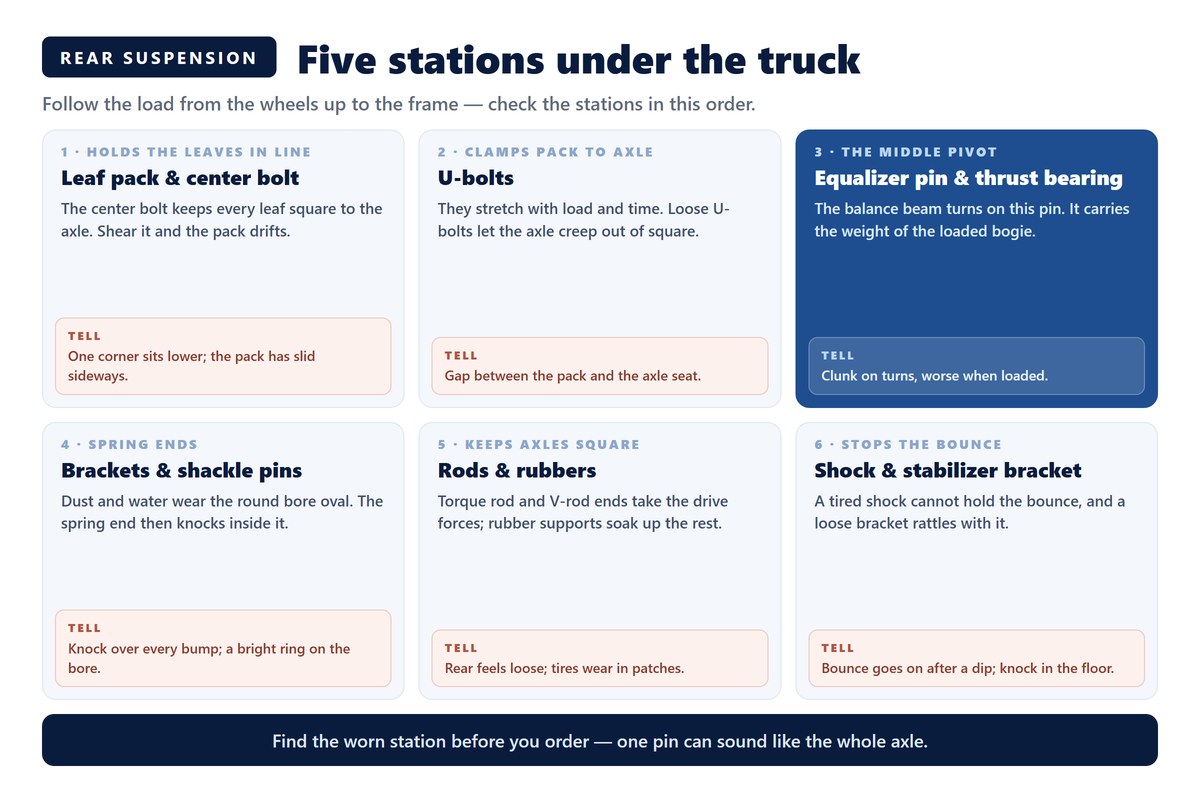
The load travels from the wheels up to the frame through five stations. Walk them in order:
- The leaf pack and its center bolt. The center bolt keeps the leaves square to the axle. A sheared bolt lets the pack drift sideways — see the center bolt 290MM M16.
- The U-bolts. They stretch with load and time; a pack that has slid sideways on the axle is the classic sign.
- The equalizer pin and its thrust bearing. The middle pivot of the balance beam carries the weight of the loaded bogie, so a worn pin knocks on every turn. Change the equalizer pin 452901814 and the thrust bearing GAC110S/K 199114520042 together.
- The brackets and shackle pins. Spring ends sit in the bracket bores, where dust and water grind the round hole oval. Check the spring bracket WG9232520010 and the rear leaf spring bracket WG9725520277/4 while the springs are out.
- The rods and the rubbers. The V-push rod AZ9725529272 and torque rods keep the axles square under drive, while the rubber supports, the shock absorber and the stabilizer bar bracket kill the bounce.
Check it with the wheels on the ground
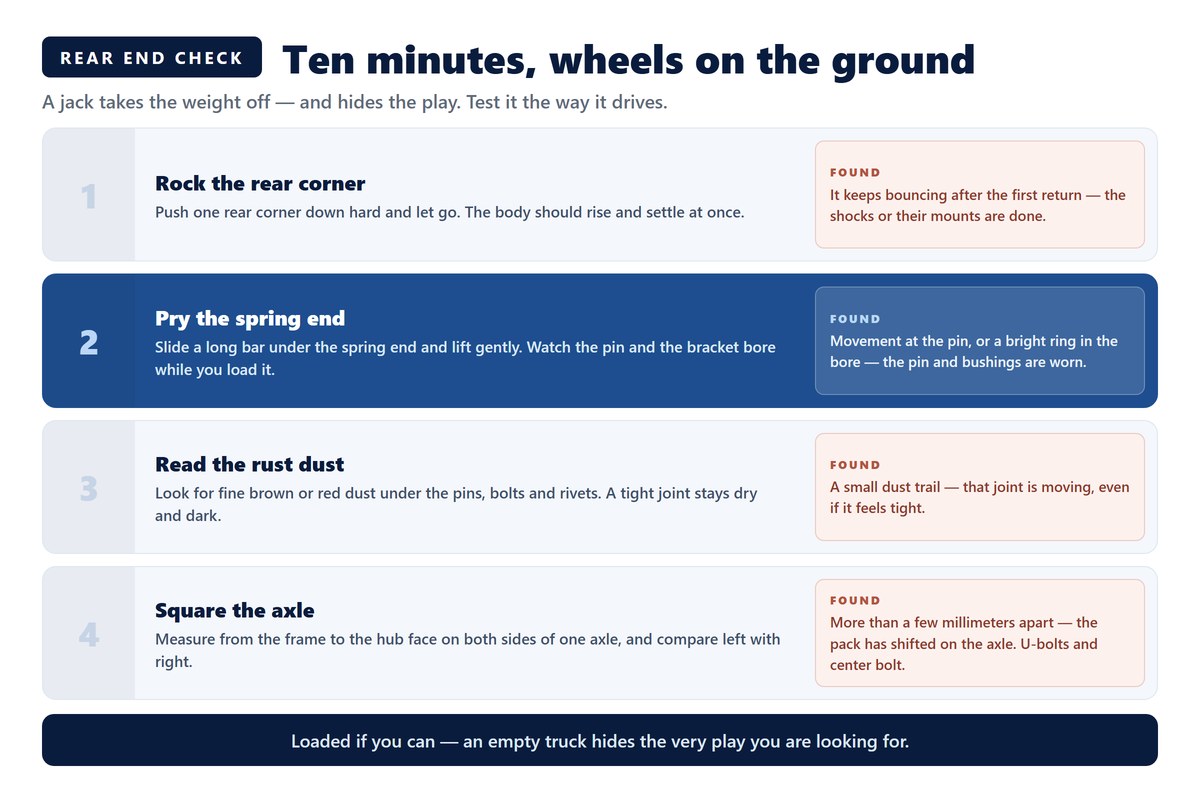
Jack the truck up and half the play hides itself, because weight is what closes a worn joint. Keep the wheels down, loaded if you can. Push one rear corner down hard and let go: the body should rise and settle at once — if it keeps rocking, start at the shocks. Lever under the spring end with a long bar: movement at the pin, or a bright ring in the bore, means worn pins and bushings. Then measure from the frame to the hub face on both sides: a gap means the pack has moved on the axle.
The rust-dust rule
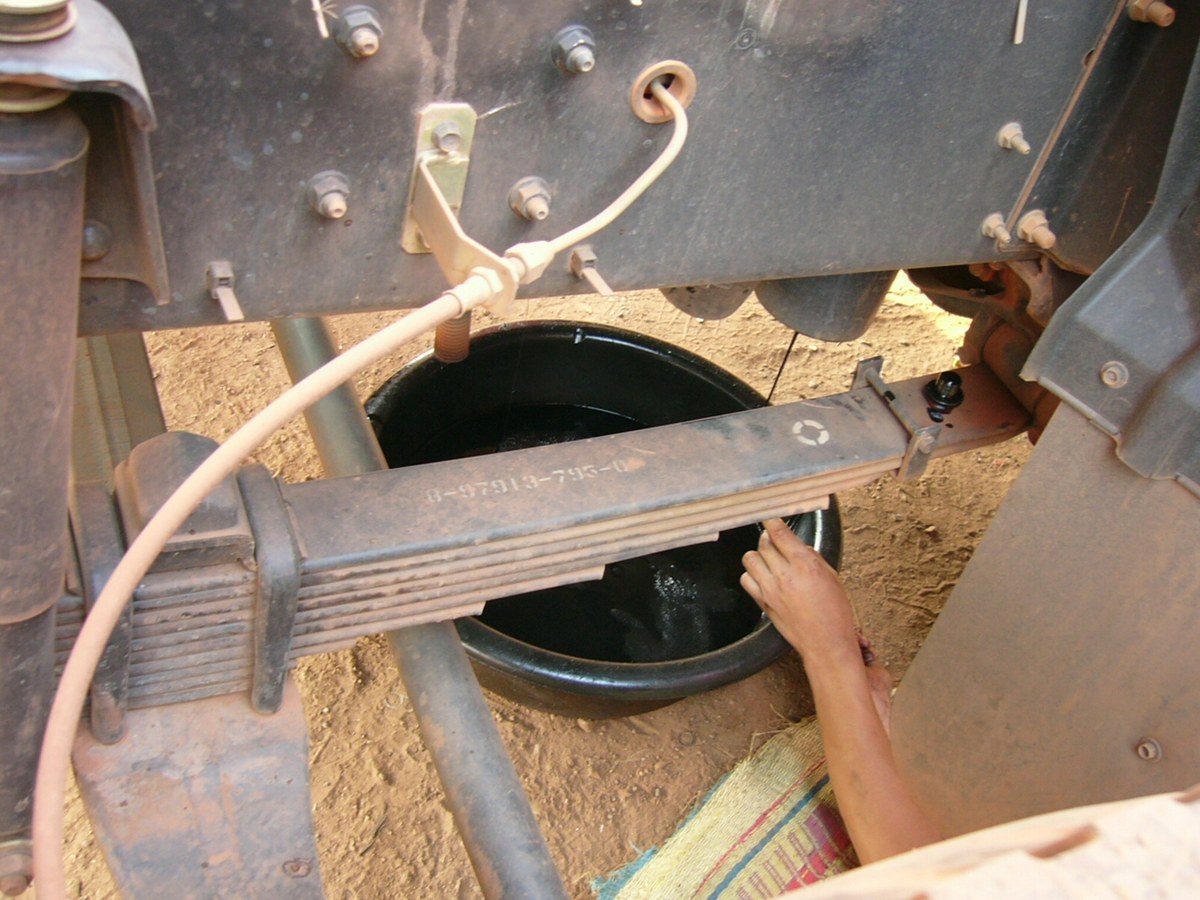
A tight joint stays dry and dark. A moving joint grinds its paint into a fine brown or red dust and builds a trail right under the worn pin. See a trail, find your joint. Grease belongs to the same story: pump the equalizer pins at every oil service until fresh grease shows at the seal. If no old grease comes out and no new grease will go in, the pin is dry — open it up.
What each sound is telling you
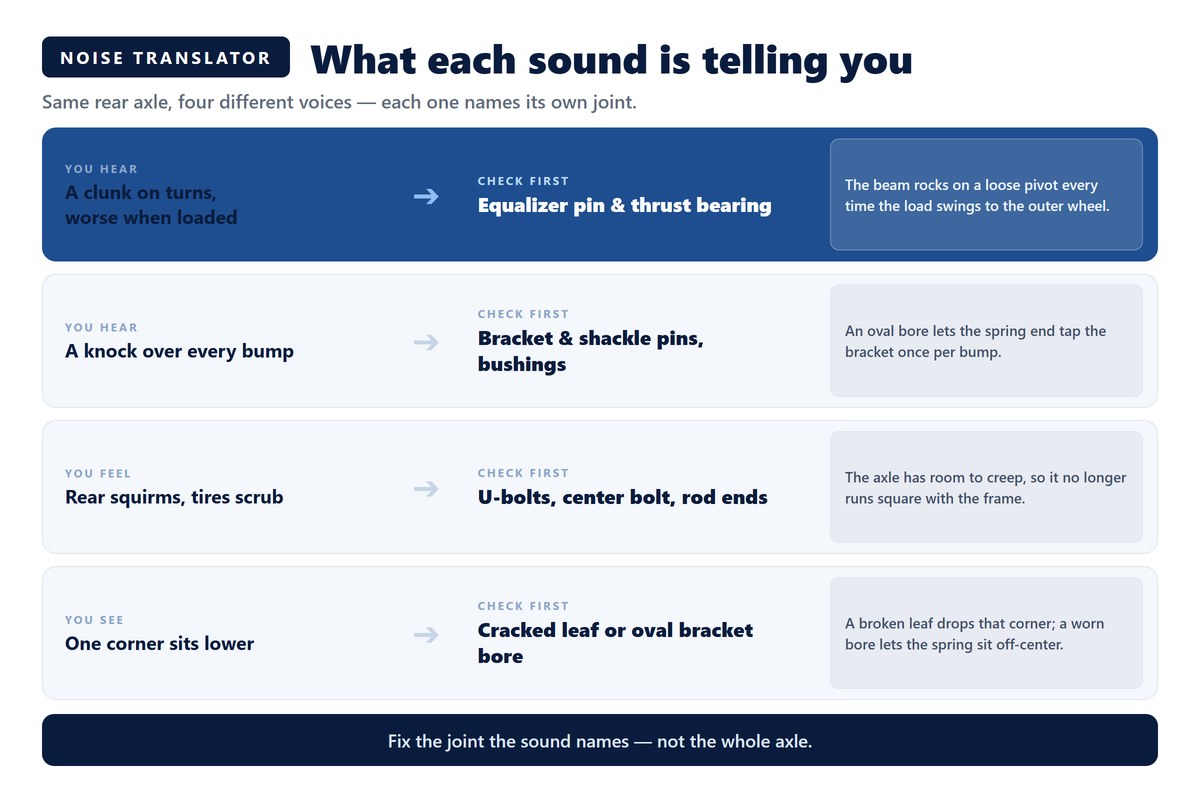
One sound, one joint. A clunk on turns names the equalizer pin. A knock on every bump names the bracket pins and bushings. A squirming rear end names the U-bolts, the center bolt or the rod ends. And one corner sitting lower names a cracked leaf or an oval bore. The suspension & steering category lists the wear parts for each station.
Fix it as a set
Pins, bushings and thrust bearings wear together, so replace them as a set — the knock then stays away for years. A new spring pack needs one more habit: re-torque the U-bolts after the first loaded week — they always relax. Dusty roads shorten every interval on this list, as our filter schedule shows. Keep the heavy wear parts on the shelf next to your roadside kit, and while you are under there, run the air brake checks from our last guide.
Send us the number from your worn part through our inquiry page. We confirm every number before we quote, and pins and bearings ship in small boxes.
Shop the Parts
Suspension & Steering — every listing carries the factory part number. Click one for the photo and full specs.
- 5001250250312 — FAW J6P JH6 Cab Height Control Valve 5001250250312
- AZ9125410223 — HOWO Arm AZ9125410223
- AZ1664430103 — HOWO Aseismic Airbag AZ1664430103
- HOWO Drag Link End (Tie Rod Joint)
- WG9925240024 — HOWO Joint Ball WG9925240024
- AZ1642430263 — HOWO Nylon Bushing AZ1642430263
- WG9725520277 — HOWO Rear Leaf Spring Bracket (Left) WG9725520277/4
- 99100680068 — HOWO Rubber Bearing 99100680068
- AZ9725591020 — HOWO Rubber Support Assy AZ9725591020
- AZ9323520010 — HOWO Rubber Support AZ9323520010
- 199114520042 — HOWO SHACMAN STEYR Equalizer Thrust Bearing GAC110S/K 199114520042
- WG1642240021 — HOWO Shock Absorber WG1642240021
Browse our range by system, or search the 264-part catalogue by part number.
- Engine Parts (57)
- Transmission (52)
- Suspension & Steering (37)
- Electrical Parts (29)
- Cabin Parts (25)
- Brake System (23)
- Chassis Parts (20)
- Cooling System (11)
- Filters (6)
- Tractor Parts (1)
Open the full parts catalogue → | Need a price? Send us the part number — we reply within 12 hours.