Electric Trucks vs Diesel: The Advantages, and the Problems Still Unsolved
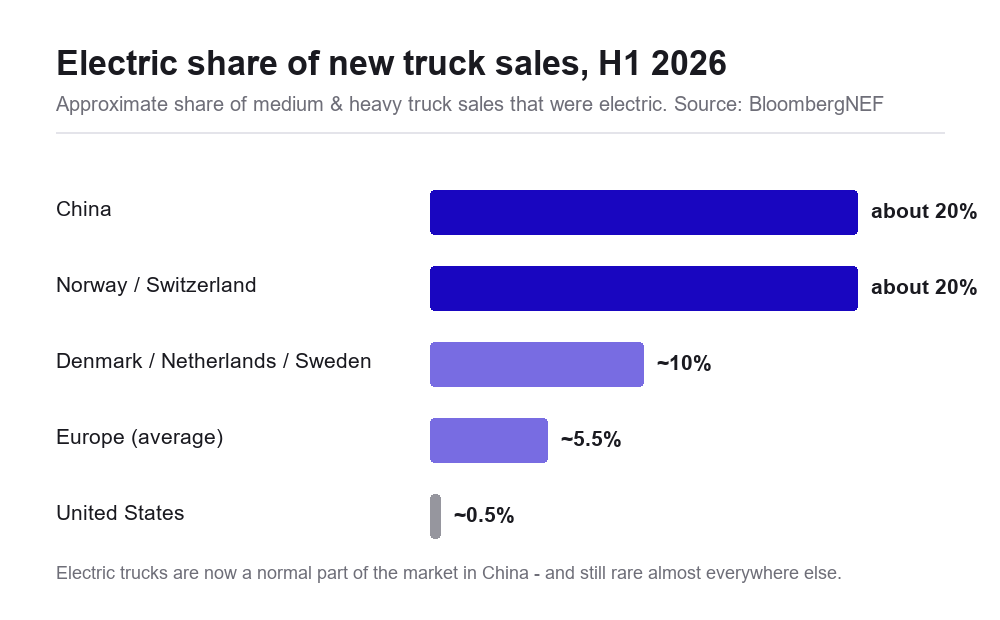
Diesel is at record highs. Electric truck sales are at record highs too: 158,000 medium- and heavy-duty electric trucks were sold worldwide in the first half of 2026, up 75% from a year earlier, according to BloombergNEF. Two records in one year – telling the same story.
The short version
- Electric trucks are cheaper to run, and they have far fewer parts to wear out.
- They still cannot cover the long corridors most of our customers drive every day.
- So the real question in 2026 is not electric or diesel. It is how well you keep the diesel truck you already own.
Now the detail.
Where electric trucks already win
1. Running cost
Fuel is 25 to 30% of a long-haul fleet’s operating cost. Electricity is cheaper per kilometre almost everywhere, and every rise in diesel prices shortens the payback period.
Put a number on that: every 20 cents on a gallon of diesel adds roughly 3 to 4 cents per mile of hauling cost. Small margins – multiplied by every kilometre your fleet runs.
2. Far fewer wearing parts
No engine oil, no oil or fuel filters, no injectors, no exhaust system. There is simply less to wear out and less to service.
3. Clean and quiet where it matters
Mine tunnels, ports, night deliveries in cities – the places where diesel is increasingly unwelcome.
But note what does not change: brakes, tyres, suspension, steering, cab and air brake parts still wear on any truck. Parts demand does not disappear. It moves.
Where electric trucks still struggle
1. Range against real routes
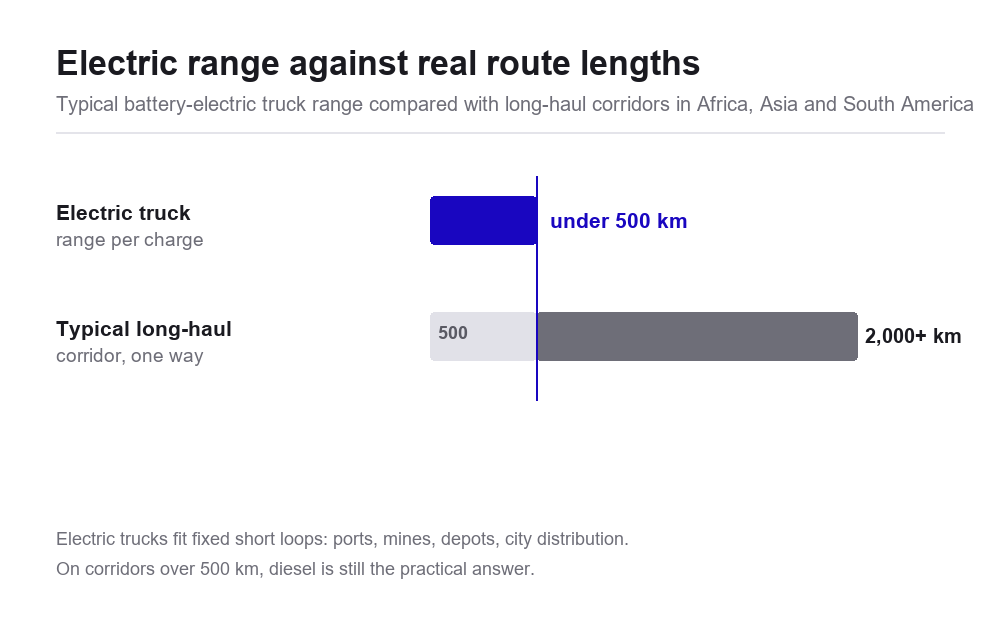
Most electric trucks on the market cover under 500 km per charge. A single long-haul trip in our markets often runs 500 to 2,000 km. Electric wins on fixed short loops and loses on the long corridor – and the long corridor is most of the freight.
2. Charging built for trucks
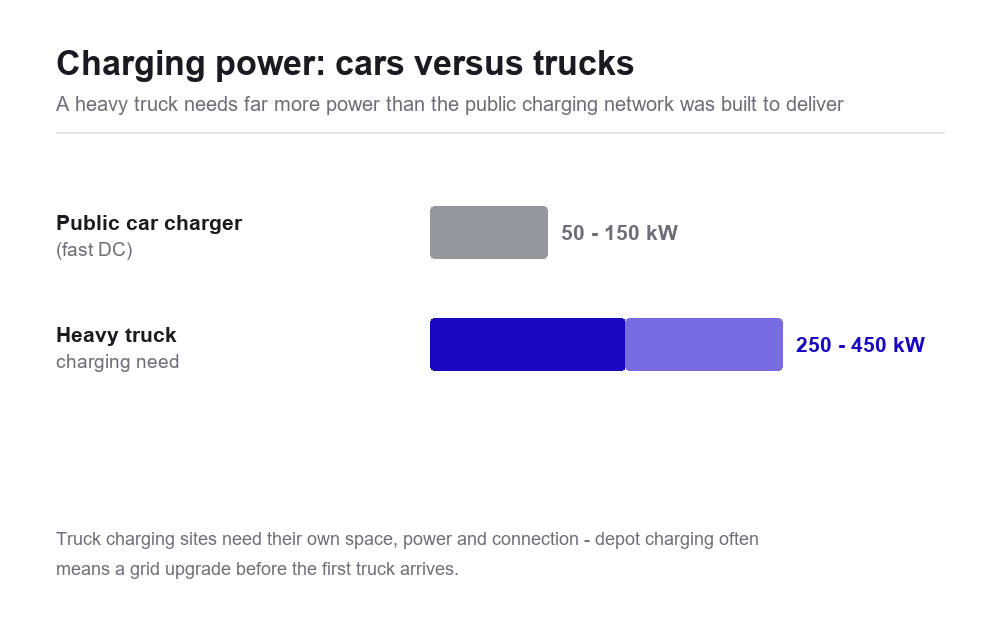
A heavy truck needs 250 to 450 kW. Public chargers were designed for cars, and depot charging often means a grid upgrade before the first truck arrives.
3. Battery life, heat, and resale value
Batteries age faster in extreme heat and dust. Nobody can yet predict what an electric truck will be worth after five years – which is why lenders increasingly underwrite the transport contract rather than the truck itself. In markets with no second-hand demand for electric trucks, that risk can outweigh the fuel saving.
4. Power you can rely on
If your depot cannot guarantee electricity, you cannot guarantee deliveries.
What you will actually spend money on
For most fleets reading this, 2026 will not be the year you switch. It will be the year fuel takes a bigger bite out of the same revenue.
If you stay with diesel – and most fleets will – then fuel economy is now a maintenance issue. Worn injectors, brakes that drag, a slipping clutch, the wrong grade of oil: all of them burn fuel at record prices. A properly maintained truck is the cheapest fuel-saving technology you can buy this year.
If you are considering electric, ask three questions before you sign anything:
- Is my route fixed and under about 400 km?
- Can my depot get reliable power at the price I was quoted?
- Who will service the battery in my country, and at what cost?
If any answer is no, the diesel truck you already own is still the right truck for now.
The bottom line. The diesel HOWO you buy this year will still be working through the whole transition. Keep it maintained and it will earn through it – and if you run one of the new electric fleets, we supply the parts that still wear: brakes, suspension, steering, cab and electrical components. Send your part number, or a photo of the old part – WG, AZ or VG – and we will match it and quote within one working day.
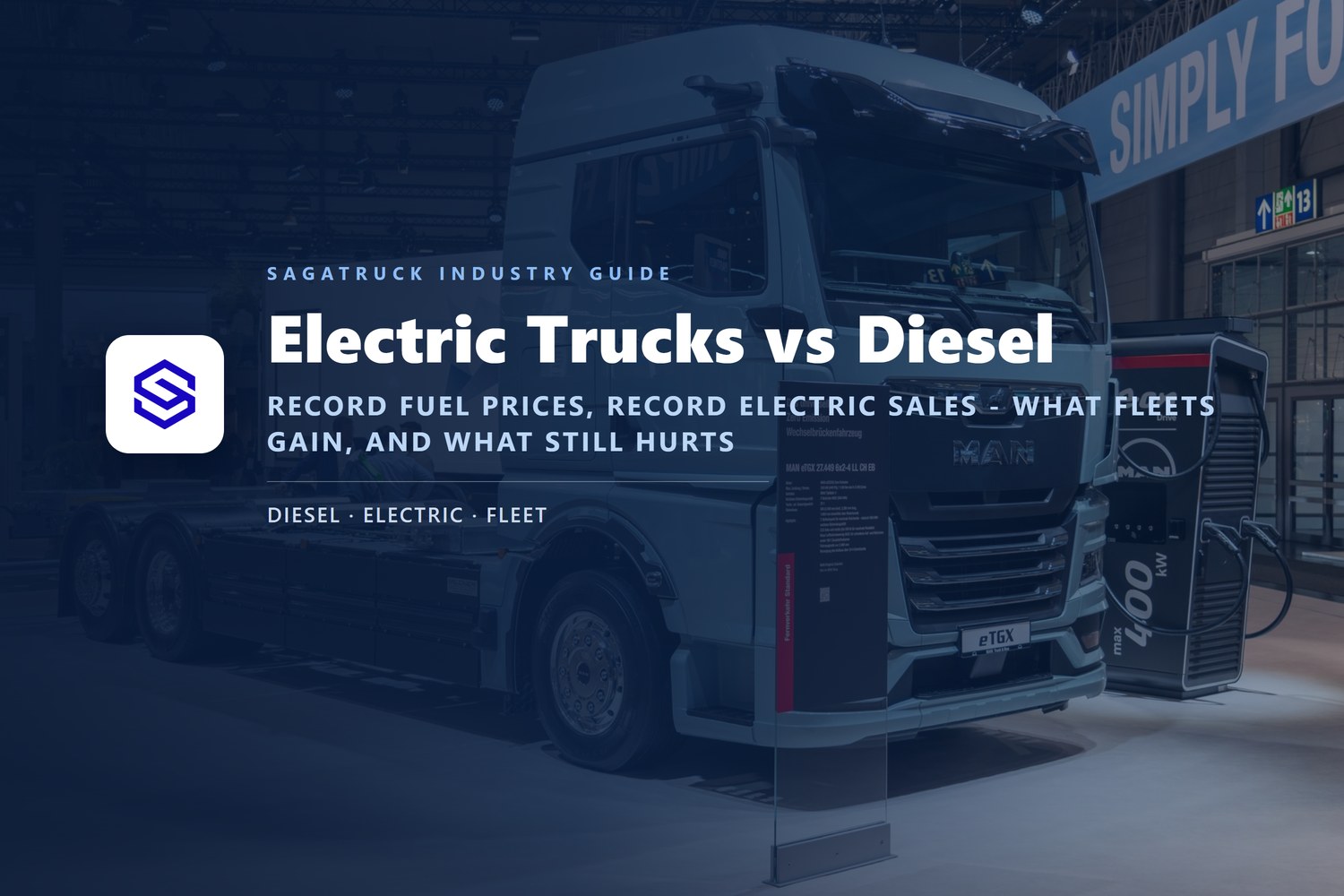
Cover photo: MAN eTGX electric truck at IAA Transportation 2024, by MarcelX42, via Wikimedia Commons, CC BY-SA 4.0 (cropped).
Shop the Parts
Engine Parts — every listing carries the factory part number. Click one for the photo and full specs.
- 1410Z00014 — Bosch Fuel Metering Valve 0 928 400 617 & 1 410 Z00 014 (0 281 002 817)
- VG1560010029 — HOWO Camshaft Bush Set VG1560010029
- WG1500139006 — HOWO Compressor WG1500139006
- VG1540030015 — HOWO Connecting Rod Bearing Set VG1540030015/0016
- VG1500030077 — HOWO Connecting Rod Bush VG1500030077
- 90003989294 — HOWO Core Plug 90003989294
- 90003989721 — HOWO Core Plug 90003989721
- VG1500040065 — HOWO Cylinder Liner VG1500040065
- VG1540010006 — HOWO Cylinder Liner VG1540010006 (ID-E137)
- AZ1246020005A — HOWO D12 Flywheel AZ1246020005A
- 1560110402 — HOWO Electric Throttle 1560110402 for Truck Engine
- WG9625570002 — HOWO Electronic Throttle WG9625570002
Browse our range by system, or search the 264-part catalogue by part number.
- Engine Parts (57)
- Transmission (52)
- Suspension & Steering (37)
- Electrical Parts (29)
- Cabin Parts (25)
- Brake System (23)
- Chassis Parts (20)
- Cooling System (11)
- Filters (6)
- Tractor Parts (1)
Open the full parts catalogue → | Need a price? Send us the part number — we reply within 12 hours.