
Is Your Truck Drinking Extra Diesel? 6 Worn Parts That Waste Fuel
The most expensive diesel you buy this year is not at the pump. It is the diesel your truck burns for nothing.
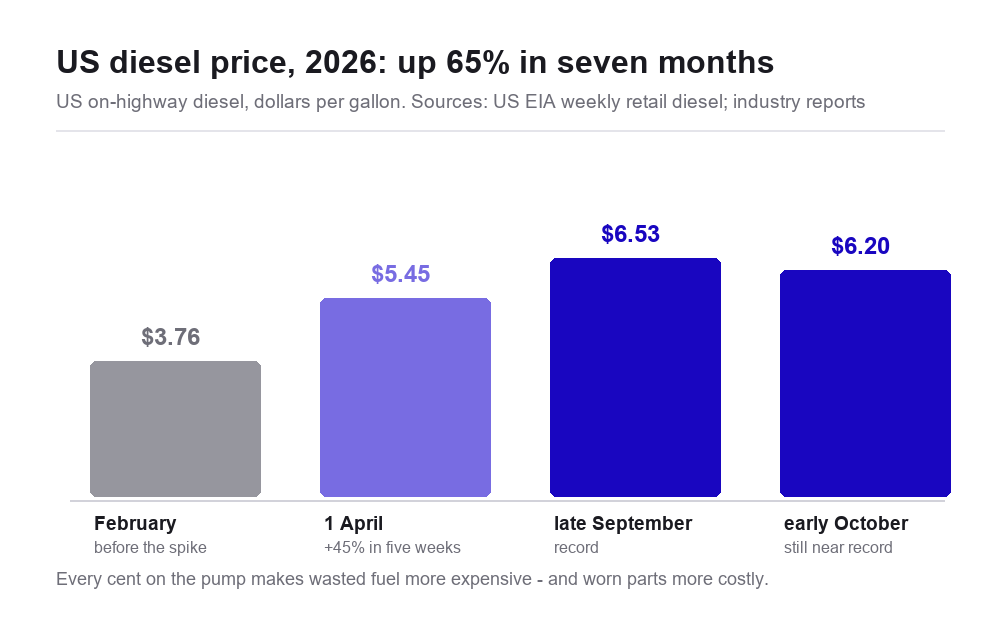
US diesel hit a record near $6.53 per gallon in late September 2026 and was still about $6.20 in early October (US EIA data). The UK passed £2 a litre for the first time. On 30 September Zambia raised pump diesel by 23.9% in one step (Energy Regulation Board). Fuel is already 20 to 30% of a truck’s running cost – every wasted litre now hurts more.
The short version
- High fuel use is usually worn parts – not a bad pump, not a bad driver.
- Six parts cause most of the silent waste: air filter, tires, dragging brakes, injectors, boost leaks, fan clutch.
- Four of the six checks are free and take ten minutes.
Six parts that drink your diesel
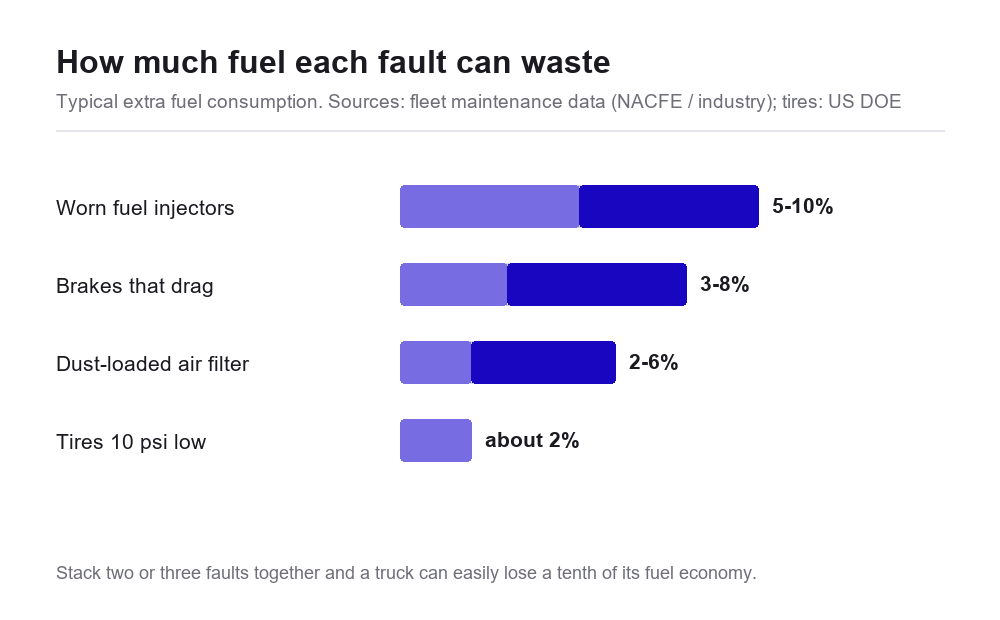
1. A dust-loaded air filter (2-6% more fuel)
On dusty roads this is the top silent killer. A blocked filter starves the engine of air, so it burns extra diesel to make the same power. Free test: hold the element up to a light. Little light passing means change it now. More on this in our dusty-road filter guide; primary air filters and safety elements are on the shelf.
2. Tires running low (about 2% at 10 psi)
The US Department of Energy counts 0.2% more fuel for every 1 psi all tires are low. Ten psi low is about 2% – and no one can see 10 psi by eye. Industry checks find only about half of truck tires within 5 psi of target.
3. Brakes that drag (3-8% more fuel)
A brake that never fully releases is a hand on the wheel all day. After a highway run, feel each hub – carefully. One hub much hotter than the rest means a dragging brake. Usual causes: slack adjusters out of adjustment, a sticking brake chamber, or a hand brake valve fault. More in our air brake leak guide.
4. Worn injectors (5-10% more fuel)
Injectors are precision parts. When the nozzle wears, the spray turns to drips. Fuel burns dirty, black smoke shows, and the engine drinks more for less power. Rough idle and hard starts are the early signs – test the injectors and the injection pump before blaming the fuel grade. Early HOWO engines use a separate injector type.
5. Boost leaks: extra fuel for less power
A split intercooler hose or a tired turbocharger lets compressed air escape. The engine burns extra fuel to do less work. Listen for a hiss under load and look for oily film around hose joints.
6. A fan clutch stuck on
The cooling fan takes real power. When a viscous fan clutch seizes, the fan runs flat out all the time and every kilometre costs extra fuel. A fan that roars from a cold start is the clue – see also our hot weather cooling checks.
Check in this order – free things first
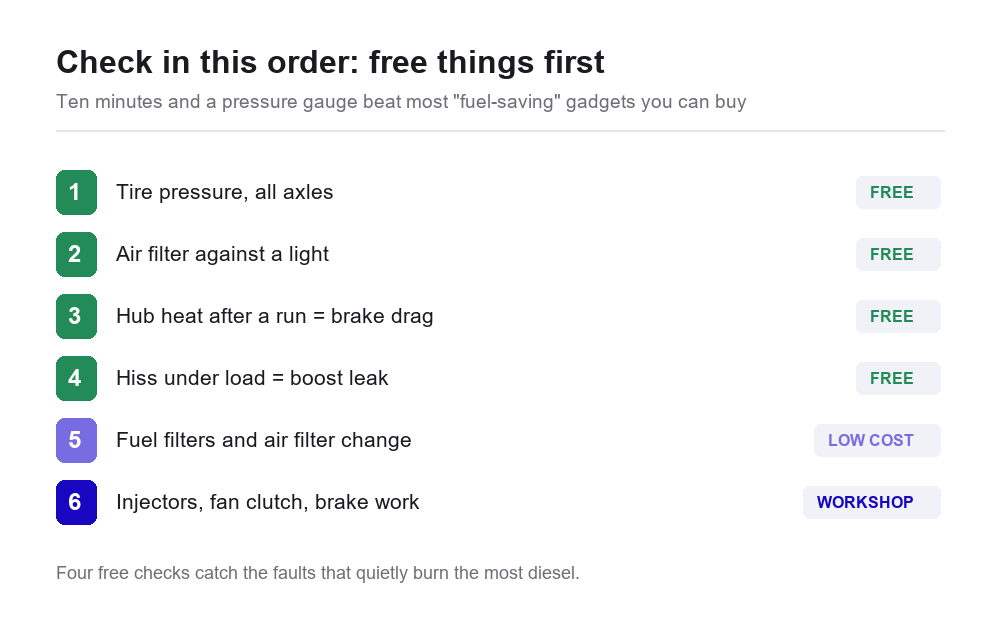
Tire pressure, air filter, hub heat, boost hiss. All four cost nothing but ten minutes. Then come the cheap parts: a fresh fuel filter and a clean air filter. Only after that, the workshop items: injectors, fan clutch, brake work.
What it is worth in money
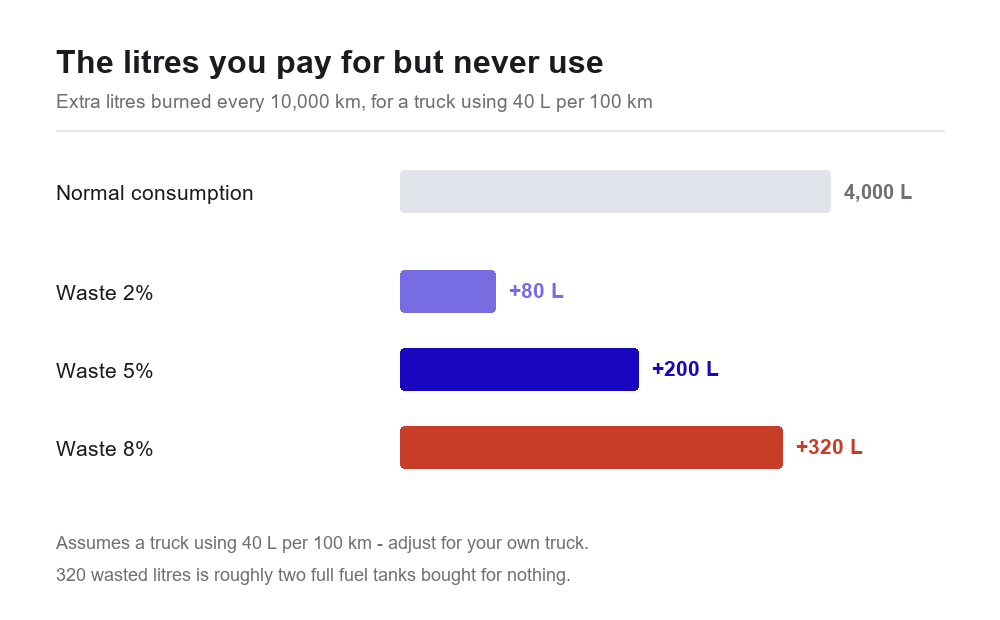
Take a truck using 40 litres per 100 km: over 10,000 km it burns 4,000 litres. Waste 2%: 80 litres you never used. Waste 5% – 200 litres. Waste 8% – 320 litres, two full tanks bought for nothing.
The bottom line. You cannot control the pump price – but you can control the six parts that waste fuel every day. Fix the free things first, then the parts. Send us your part number, or a photo of the old part – WG, AZ or VG – and we will match it and quote within one working day.
Shop the Parts
Engine Parts — every listing carries the factory part number. Click one for the photo and full specs.
- 1410Z00014 — Bosch Fuel Metering Valve 0 928 400 617 & 1 410 Z00 014 (0 281 002 817)
- VG1560010029 — HOWO Camshaft Bush Set VG1560010029
- WG1500139006 — HOWO Compressor WG1500139006
- VG1540030015 — HOWO Connecting Rod Bearing Set VG1540030015/0016
- VG1500030077 — HOWO Connecting Rod Bush VG1500030077
- 90003989294 — HOWO Core Plug 90003989294
- 90003989721 — HOWO Core Plug 90003989721
- VG1500040065 — HOWO Cylinder Liner VG1500040065
- VG1540010006 — HOWO Cylinder Liner VG1540010006 (ID-E137)
- AZ1246020005A — HOWO D12 Flywheel AZ1246020005A
- 1560110402 — HOWO Electric Throttle 1560110402 for Truck Engine
- WG9625570002 — HOWO Electronic Throttle WG9625570002
Browse our range by system, or search the 264-part catalogue by part number.
- Engine Parts (57)
- Transmission (52)
- Suspension & Steering (37)
- Electrical Parts (29)
- Cabin Parts (25)
- Brake System (23)
- Chassis Parts (20)
- Cooling System (11)
- Filters (6)
- Tractor Parts (1)
Open the full parts catalogue → | Need a price? Send us the part number — we reply within 12 hours.