Why Your HOWO Overheats in Hot Weather — and What to Check First
Heat beats a tired cooling system
In much of Africa, the Middle East and South America, the road itself is hot. On a 40°C day, a loaded HOWO makes more heat than a tired cooling system can pass out. Overheating does not kill an engine in one trip. It works slowly: the oil thins, the pistons run hot, and one day the head gasket gives up.
The good news: cooling is a chain of simple links, and one afternoon checks them all.
The cooling chain
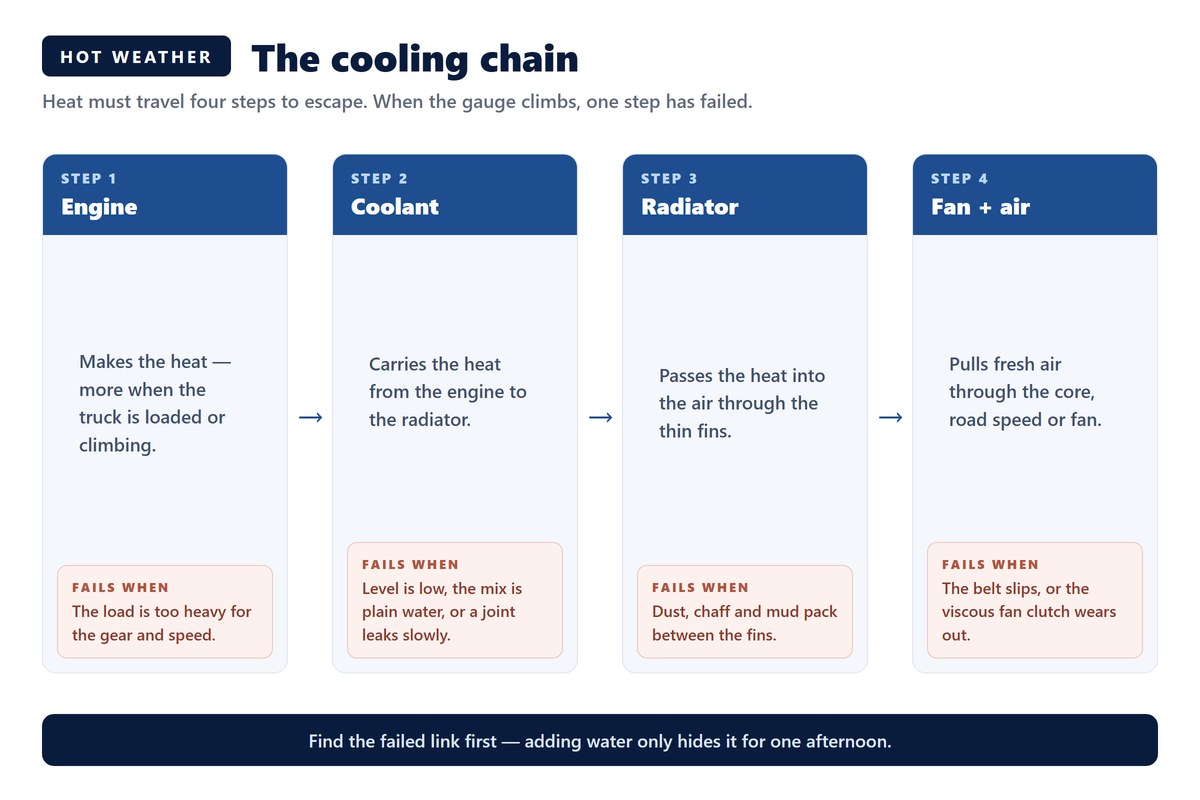
Heat moves in four steps. The engine makes it. The coolant carries it. The radiator passes it into the air. The fan and the road air pull it away. When the gauge climbs, one link has failed — find the link instead of just adding water.
Check the links in order: cheapest first
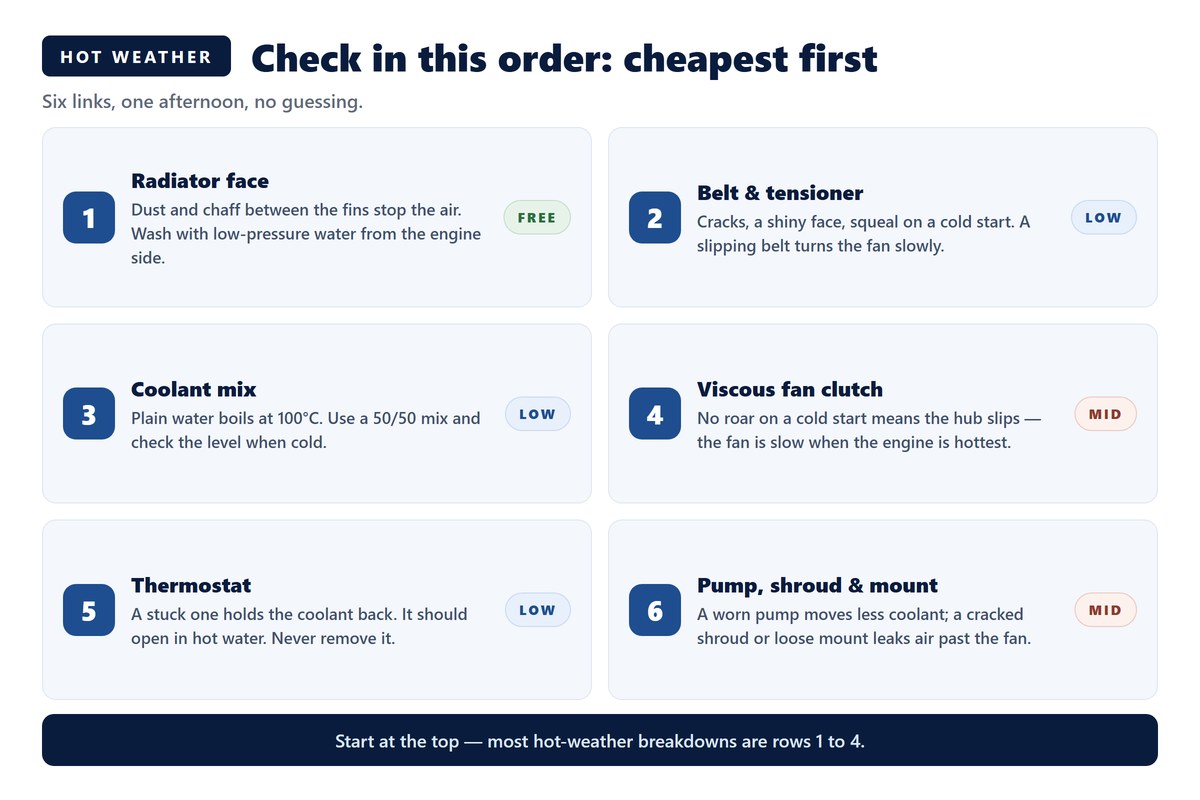
- The radiator face (free). Dust, chaff and mud pack between the fins, so a radiator can be full of coolant and still overheat. Wash it with low-pressure water from the engine side, so the dirt comes out the way it went in.
- The belt and tensioner (cheap). A loose or glazed belt slips, and a slipping belt turns the fan slowly. Look for cracks and a shiny face, and listen for squeal on a cold start. A new ribbed belt 8PK1068 or 8PK1160 costs little, and so does a tensioner pulley.
- The coolant mix (cheap). Plain water boils at 100°C and rusts the water pump; a 50/50 coolant mix boils much hotter. Check the level when the engine is cold, and look for green or white crust at the joints — a slow leak at a cooler tube shows up there first.
- The viscous fan clutch (the hidden one). HOWO trucks drive the fan through a small clutch filled with thick oil. When it is healthy, the fan roars loudly for a moment on every cold start — that is the clutch locked. When it wears out, it slips, and the fan turns slowly exactly when the engine is hottest. No cold-start roar usually means the clutch is worn.
- The thermostat. A thermostat stuck partly closed holds the coolant back and hides its heat in the engine. A quick test: it should open in a pot of hot water. Never remove it — see below.
- The pump, the shroud and the mount. A worn pump moves less coolant. A cracked fan shroud lets the fan pull air around the radiator instead of through it, and a loose fan mount does the same.
What a worn link looks like
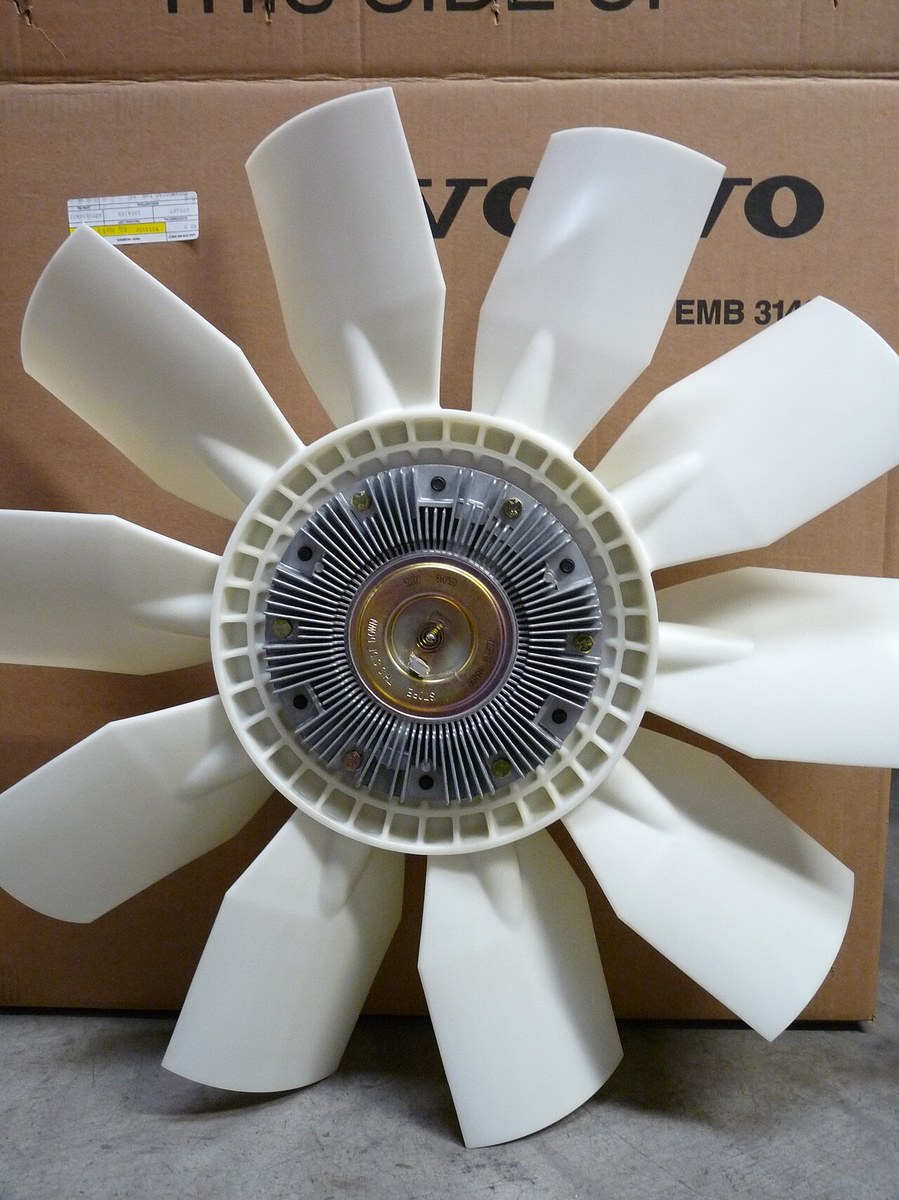
The blades look fine, the belt turns, the fan spins — but too slowly to pull enough air. This is why a truck can overheat with no visible leak and a full radiator.
Three habits that make hot weather worse
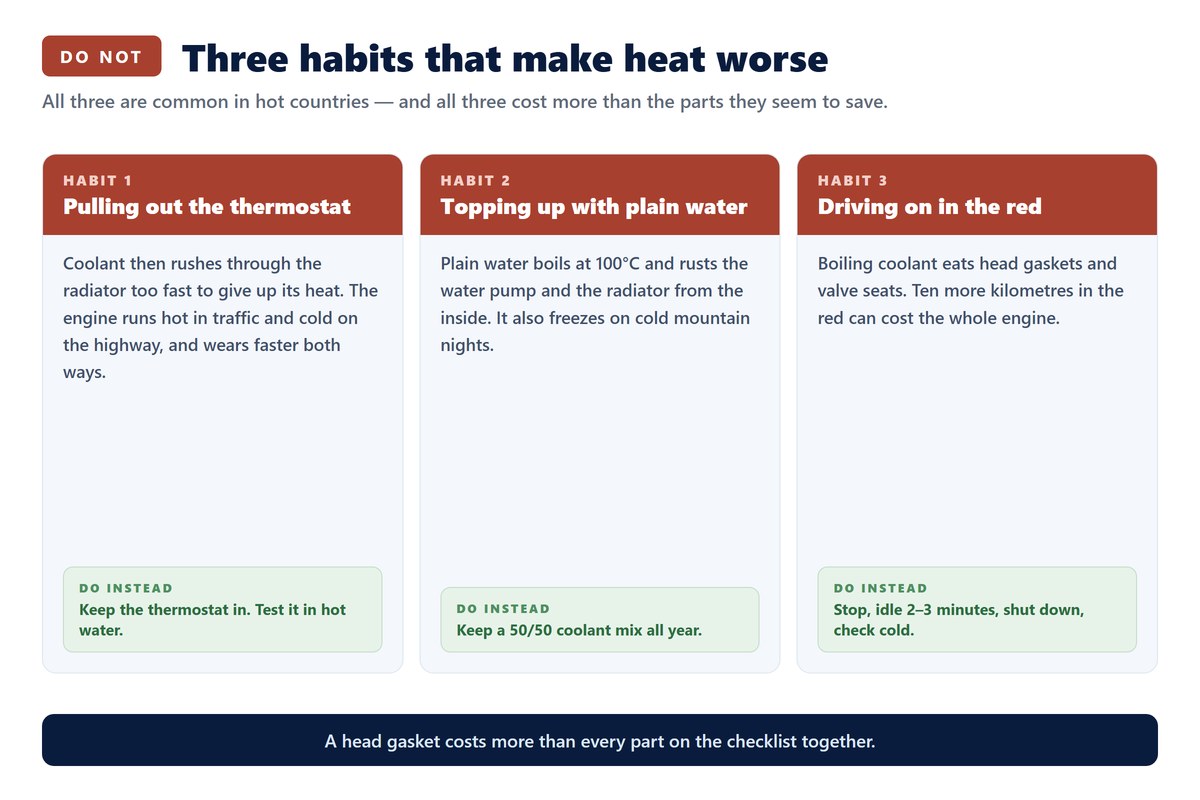
If the gauge climbs while you drive, stop as soon as it is safe. Let the engine idle for two or three minutes with the fan turning, then shut it down. Check the coolant level only when the engine is cold, and never open a hot radiator cap.
Do the cheap checks before the hot season
Wash the radiator face, look at the belt, and listen for the cold-start fan roar — those three cover most hot-weather breakdowns. For the service intervals behind them, read our dusty-road filter schedule. For the wet half of the year, see the rainy-season water checks. And before you buy any part, confirm the grade with our genuine, OEM or copy guide — the full cooling range sits in our cooling system category, from the viscous fan clutch 202V06600-7060 down to hoses.
Send us your truck model and the part numbers you need through our inquiry page. Fan clutches, belts and shrouds ship in small boxes, and we confirm every number before we quote.
Shop the Parts
Cooling System — every listing carries the factory part number. Click one for the photo and full specs.
- WG9925530058 — HOWO Cooler Tube WG9925530058
- 61260061438 — HOWO Fan Mount 61260061438
- WG9725530605 — HOWO Fan Shroud WG9725530605
- WG9725530006 — HOWO Sewer Pipe Joint WG9725530006
- 150701000855B — SANY Electronic Water Pump ECP200-2 150701000855B
- VG2600020226 — Sinotruk Ribbed Belt 8PK1068 VG2600020226
- 202V06600-7060 — Sinotruk Viscous Fan Clutch 202V06600-7060
- 80QSB-60/90 — Truck Sprinkler Water Pump 80QSB-60/90
- 612640060227 — Weichai Open Fan Blade 612640060227 WP12 WP13
- 11KFW111-09343 — XCMG Intercooler Hose 11KFW111-09343
- NXG11TFW111-09353 — XCMG Intercooler Hose NXG11TFW111-09353
Browse our range by system, or search the 264-part catalogue by part number.
- Engine Parts (57)
- Transmission (52)
- Suspension & Steering (37)
- Electrical Parts (29)
- Cabin Parts (25)
- Brake System (23)
- Chassis Parts (20)
- Cooling System (11)
- Filters (6)
- Tractor Parts (1)
Open the full parts catalogue → | Need a price? Send us the part number — we reply within 12 hours.
Parts related to this article
- WG9925530058 - HOWO Cooler Tube WG9925530058
- 9347144030 - SINOTRUK HOWO Four-Circuit Protection Valve WABCO 9347144030 (Genuine, WG9000360523/1)
- YZ166424000017 - SINOTRUK HOWO TX / NX Headlamp Protection Grille Pair YZ166424000017 (L+R, Cross YZ166424000015)
- AZ000093000729 - SINOTRUK HOWO NX Front Bumper Guard Assembly AZ000093000729 (Chrome, SINOTRUK Logo)