Diesel Jumped 24% Overnight. Who Pays? The Fuel Clause
The short version: ① Diesel rose 23.9% in Zambia at a single monthly reset, and hit a record $6.53 a gallon in the US – fuel is now trucking’s No.1 issue. ② A fuel surcharge clause turns the spike into arithmetic: (pump price – base price) x litres burned per 100 km. ③ Four numbers in writing: base price, base burn, review lag, empty km.
At midnight on 30 September, Zambia’s Energy Regulation Board lifted diesel from K26.86 to K33.27 a litre. One reset, 23.9% up. Your trucks burned it the next morning – but the haulage rate you agreed months ago did not move. Guess who paid for that gap.
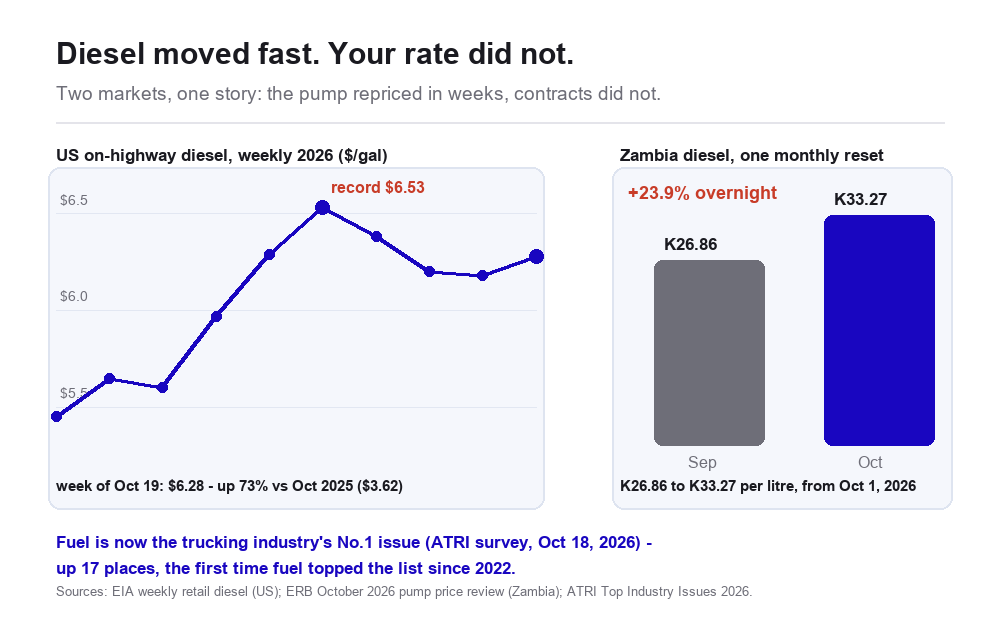
This is not only Zambia. US diesel hit a record $6.53 a gallon in September, about 73% above a year earlier, and the American Transportation Research Institute now ranks fuel as trucking’s No.1 issue – up 17 places, the first time since 2022. Its researchers also wrote: fuel surcharges do not fully insulate carriers from a price spike.
1. What the clause actually does
A fuel surcharge is a small, formula-based extra on top of your rate. It moves with the pump price, so nobody renegotiates mid-trip. One line decides everything: the base price – the diesel price you both agreed on signing day.
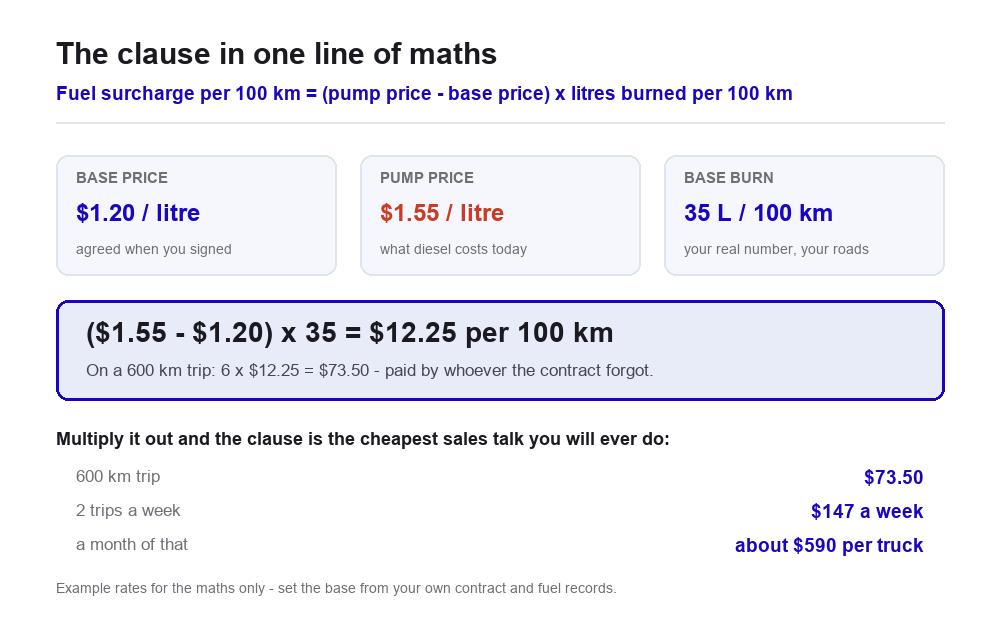
Example: base $1.20 a litre, pump $1.55, truck burning 35 litres per 100 km. The surcharge is $0.35 x 35 = $12.25 per 100 km. On a 600 km trip that is $73.50 – money that used to come out of your margin.
2. Three places the clause leaks
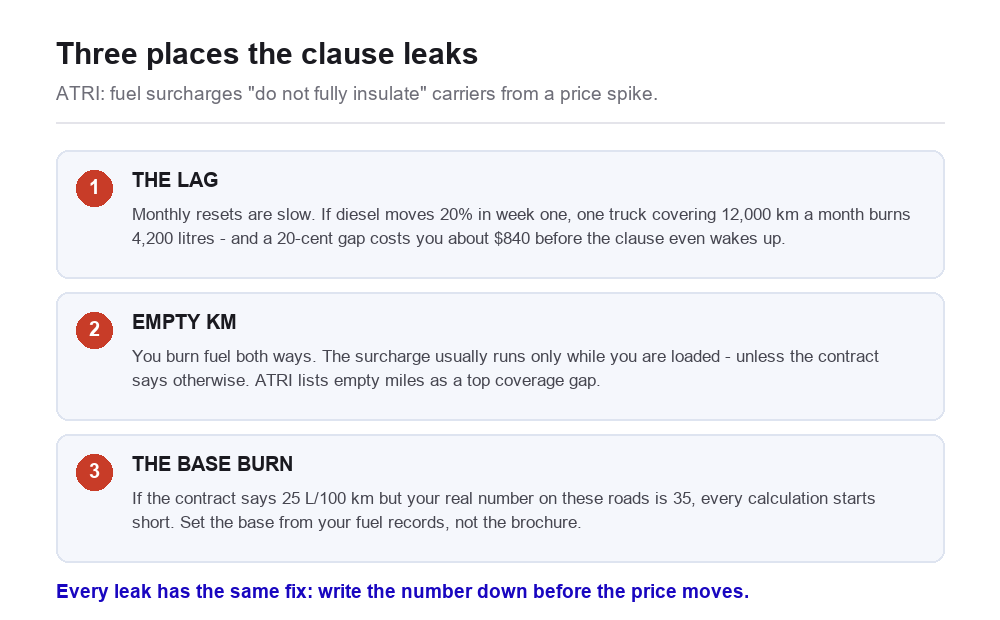
The lag. Many contracts adjust monthly. If diesel moves 20% in the first week, one truck covering 12,000 km that month burns 4,200 litres – a 20-cent gap costs about $840 before the clause even wakes up.
The empty kilometres. You burn fuel both ways, but the surcharge usually runs only while loaded. ATRI lists empty miles among the top coverage gaps.
The base burn. If the contract says 25 litres per 100 km but your real number is 35, every calculation starts short. Set the base from your own fuel records, not the brochure.
3. Four numbers to put in writing
Before the next renewal, agree four numbers in writing:
1. Base price, and its source: which pump or index, on which date.
2. Base burn: litres per 100 km, from your own records.
3. Review lag: weekly, or capped at 14 days – monthly is slow in a spike.
4. Empty km: a fixed share of the loaded rate, or burn counted door to door.
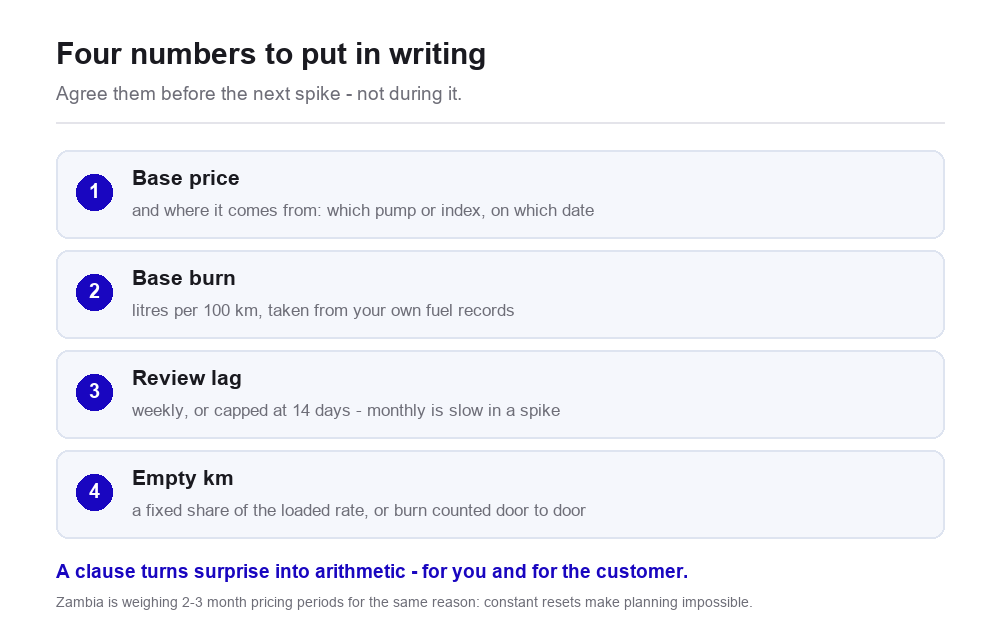
Zambia’s president now proposes two- to three-month pricing periods, because constant change makes planning impossible. Your clause does the same job – it turns surprise into arithmetic.
4. What no clause will cover
The clause protects the price of a litre – not the litres you waste: idling, empty detours, mechanical drag (the six worn parts that waste the most fuel). A worn fuel injector R61540080017A, a tired pre-fuel filter WG9412551201, a leaking hand primer pump VG1500080100 or a blocked air filter P628326 burns fuel no formula gives back. ATRI puts non-fuel costs at a record $1.854 per mile, with truckload margins below 1% – the litres you control matter as much as the price you cannot.
The bottom line
Diesel moved 23.9% in one night; your rate moved not at all. Base price, base burn, short review lag, empty km in writing – the whole clause fits on half a page.
Running HOWO or SHACMAN trucks and watching your burn creep past the base? Send the part numbers – or a photo of the old part – and we reply with a quote within one working day.
Cover photo: Scania G410 tractor with fuel tanker trailer at a Petron station, Philippines. Captainmorlypogi1959, CC0, via Wikimedia Commons.
Shop the Parts
Engine Parts — every listing carries the factory part number. Click one for the photo and full specs.
- 1410Z00014 — Bosch Fuel Metering Valve 0 928 400 617 & 1 410 Z00 014 (0 281 002 817)
- VG1560010029 — HOWO Camshaft Bush Set VG1560010029
- WG1500139006 — HOWO Compressor WG1500139006
- VG1540030015 — HOWO Connecting Rod Bearing Set VG1540030015/0016
- VG1500030077 — HOWO Connecting Rod Bush VG1500030077
- 90003989294 — HOWO Core Plug 90003989294
- 90003989721 — HOWO Core Plug 90003989721
- VG1500040065 — HOWO Cylinder Liner VG1500040065
- VG1540010006 — HOWO Cylinder Liner VG1540010006 (ID-E137)
- AZ1246020005A — HOWO D12 Flywheel AZ1246020005A
- 1560110402 — HOWO Electric Throttle 1560110402 for Truck Engine
- WG9625570002 — HOWO Electronic Throttle WG9625570002
Browse our range by system, or search the 264-part catalogue by part number.
- Engine Parts (57)
- Transmission (52)
- Suspension & Steering (37)
- Electrical Parts (29)
- Cabin Parts (25)
- Brake System (23)
- Chassis Parts (20)
- Cooling System (11)
- Filters (6)
- Tractor Parts (1)
Open the full parts catalogue → | Need a price? Send us the part number — we reply within 12 hours.