Turbo: Rebuild or Replace? The Four Gates That Decide
The short version: ① More than 90% of turbo failures are oil-related, and under 1% come from manufacturing defects (Garrett). Fix the cause first, or the next turbo dies the same way. ② A professional rebuild saves 50-70% against a new unit – but only when the old one passes inspection. ③ Four findings mean replace, not rebuild: wheel-to-housing contact, cracked housing, bent shaft, broken blades.
The dealer quotes $6,000 for a new turbocharger. Your workshop friend says $800 will rebuild the one in his hand. Both numbers can be right – for different turbos. The skill is knowing which one is sitting on your bench.
1. Why turbos actually die
Turbo maker Garrett calls them the three turbo killers: oil starvation, oil contamination and foreign object damage. More than 90% of failures are oil-related. On African, Middle East and island roads, dust works both sides: it grinds past a tired air filter into the compressor, and it shortens oil life until the bearings ride on abrasive carbon instead of clean oil.
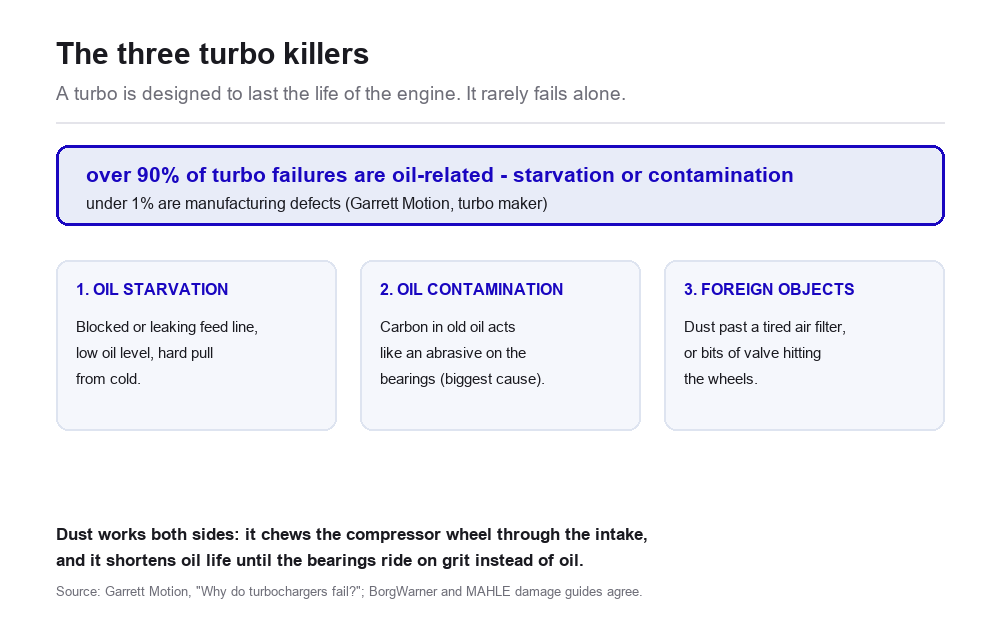
So before you spend anything on a turbo, check the cheap parts that kill it: a clogged oil filter VG1092080052, a dust-loaded primary air filter P628326, a leaking intercooler hose WG9730530011. Garrett’s own rule: a new turbo fitted without fixing the cause will fail the same way – and the warranty will not cover it.
2. The money, in one chart
For a heavy-duty diesel turbo, 2026 shop pricing runs like this: a rebuild with a new bearing kit, $500-$1,200. A remanufactured unit, $2,100-$3,600. A new OEM turbo, $3,000-$10,000. A good rebuild saves 50-70% against new – when the core qualifies.
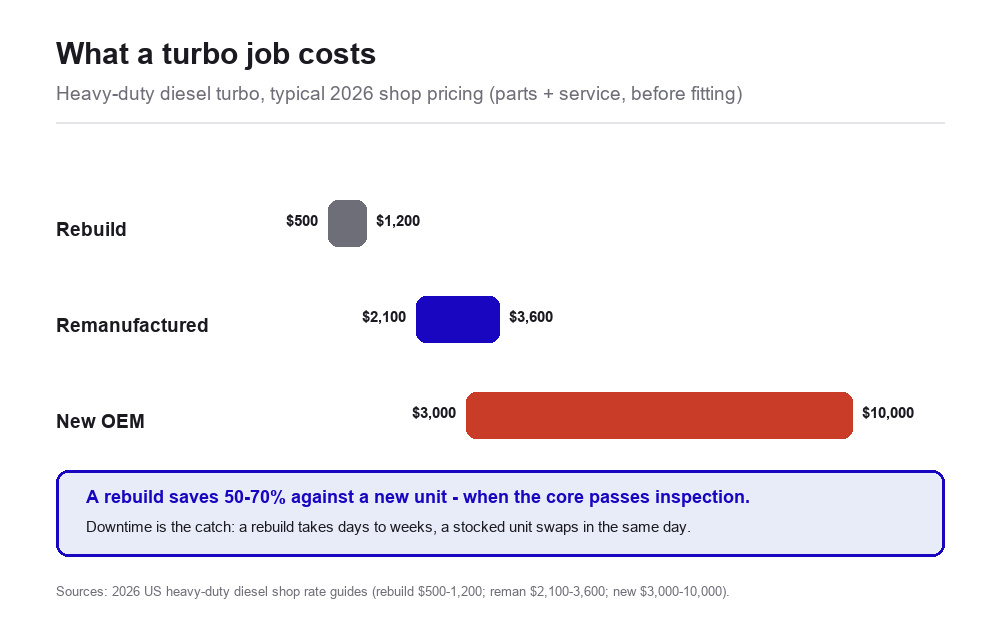
But weigh downtime too. A rebuild means days to weeks while your core sits on a bench; a stocked unit swaps in the same day. At $500-$1,000 a day for a truck off the road, the savings can quietly disappear. For HOWO and SHACMAN trucks, the fast route is often a complete turbocharger VG1034110061 (Holset HX55W type) shipped with the next container.
3. The four gates
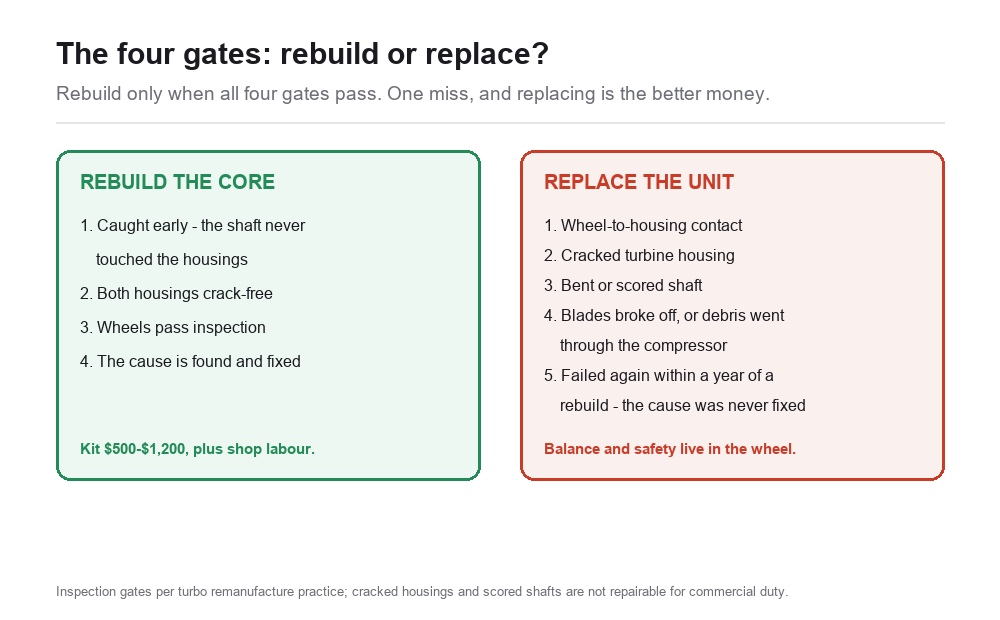
Open the core – or have your shop do it – and run four gates. Rebuild only when all four pass: the failure was caught before the wheels touched the housings; both housings are crack-free; the wheels pass inspection; and the cause is found and fixed.
One miss, and the maths flips: a rubbed wheel is bent and out of balance, a polished shaft cannot be saved, and a cracked turbine housing cannot be repaired for commercial duty. A turbo that failed again within a year of a rebuild is telling you the cause was never fixed – fit a fresh unit and diagnose the engine side instead.
4. Make the next one last
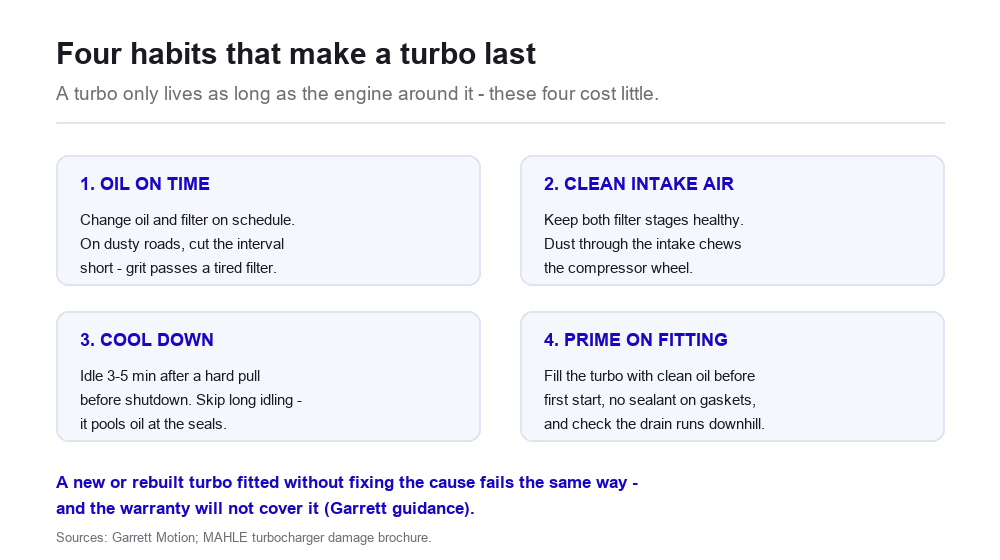
1. Change oil and filter on schedule – on dusty roads, shorter (see dusty-road filter intervals).
2. Keep intake air clean at both stages, and add the safety filter P629466 if your truck runs without one.
3. Idle three to five minutes before shutdown after a hard pull; avoid long idling – it lets oil pool at the seals.
4. Prime a new or rebuilt turbo with oil before first start, and check the drain runs downhill.
The bottom line
Rebuild when the core passes all four gates and the cause is fixed. Replace when any gate fails. Either way, the oil habit decides how long it lives.
Running HOWO or SHACMAN trucks? Send the number cast on your turbo housing – or a photo of the old unit – and we reply with a quote within one working day.
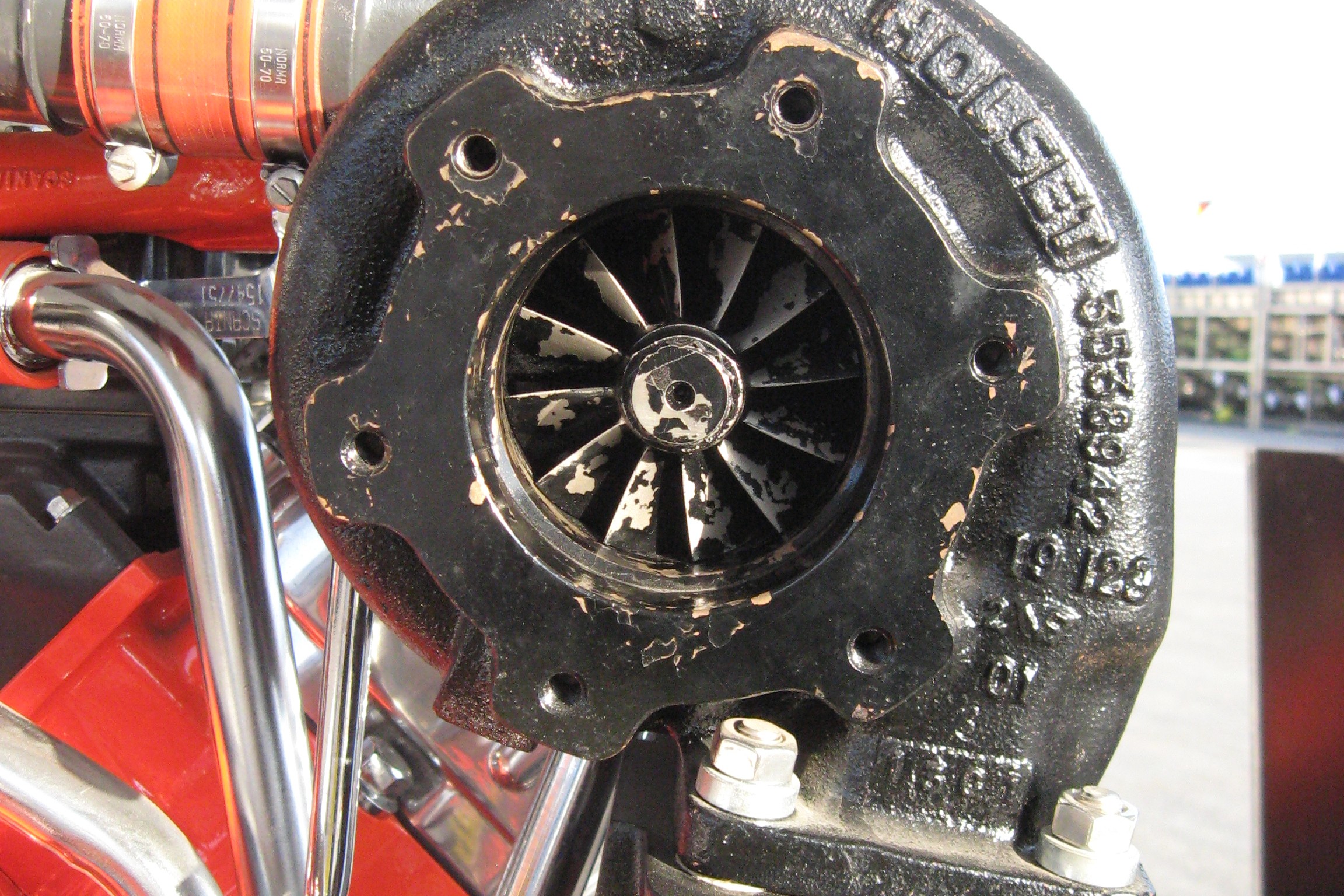
Cover photo: turbocharger assembly on a truck diesel engine. Panoha, CC BY-SA 3.0, via Wikimedia Commons. Article photo: Holset turbocharger on a Scania engine. liftarn, CC BY-SA 2.0, via Wikimedia Commons.
Shop the Parts
Latest part numbers — every listing carries the factory part number. Click one for the photo and full specs.
- 3501205CA10 — FAW Jiefang Brake Expander Module 3501205CA10 for J6P / JH6 / J7 (H20003)
- 9347144030 — SINOTRUK HOWO Four-Circuit Protection Valve WABCO 9347144030 (Genuine, WG9000360523/1)
- YZ166424000017 — SINOTRUK HOWO TX / NX Headlamp Protection Grille Pair YZ166424000017 (L+R, Cross YZ166424000015)
- AZ000093000729 — SINOTRUK HOWO NX Front Bumper Guard Assembly AZ000093000729 (Chrome, SINOTRUK Logo)
- AZ020093000444 — SINOTRUK HOWO NX Front Guard Spacer Sleeve AZ020093000444 (Pair)
- AZ000093000730 — SINOTRUK HOWO NX Front Bumper Guard Mounting Bracket Kit AZ000093000730 (Pair + Axle + Washers + Bolts)
- EZ9225580004 — SINOTRUK HOWO Central Control Unit EZ9225580004 with Remote Key (Central Locking Module)
- WG9719584011 — HOWO Light Switch WG9719584011 & Cab Rocker Switch Assortment (12 Types)
- WG9716580023 — SINOTRUK HOWO CBCU3 Body Control Unit WG9716580023 (Continental A2C396510800, 24V)
- WG9725471016 — HOWO Power Steering Pump WG9725471016 Gear Drive (17-Tooth, A7 T5G T7H)
- WG9730530011 — HOWO Intercooler Hose WG9730530011 for T7H / Sitrak C7H (MC11 MC13)
- WG9716580021 — HOWO Electrical Junction Box Assembly WG9716580021 (Fuse & Relay Box)
Browse our range by system, or search the 264-part catalogue by part number.
- Engine Parts (57)
- Transmission (52)
- Suspension & Steering (37)
- Electrical Parts (29)
- Cabin Parts (25)
- Brake System (23)
- Chassis Parts (20)
- Cooling System (11)
- Filters (6)
- Tractor Parts (1)
Open the full parts catalogue → | Need a price? Send us the part number — we reply within 12 hours.